
How Much Does A Transparent Screen Cost Per Square Meter? When I Opened The Store, I Asked All Three Suppliers.
I have been running a boutique clothing store for three years. Last year, I replaced the floor-to-ceiling glass in two stores with transparent screen equipment.
Prior to this, I went to the building materials market for more than two months of investigation. During this period, I inquired about no less than ten manufacturers that produce transparent screens. The price ranges quoted by these manufacturers spanned a very wide range. The price per square meter was as low as 2,800 yuan and as high as 12,000 yuan. This uneven market quotation made people dazzled and had no choice. Today, I want to break down the things you are asking about and explain them clearly. This is a rough explanation for those friends who are just planning to use transparent screens to make windows, partitions, or display cabinets. The purpose of doing this is to save you from wasting time and not having to travel so hard.
How much does a transparent screen cost per square meter?
Among the prices I received here, the cheapest one was probably 2,800 yuan per square meter. It uses a P2.5 specification module. The pixel density performance of this module is average. Although the effect is okay when viewed from a distance, as soon as you look closer, you can clearly feel the graininess on the screen.
However, the white balance of that display has a bit of a bluish tint. If you leave the screen on all night, you will pay an additional four to five hundred yuan in electricity bills every month. Moreover, the daily maintenance is also troublesome. Once a pixel on the screen is damaged, the entire module must be replaced, and the labor cost for this is even more expensive than the module itself.
The price of a mid-range display screen is about 4,000 to 6,000 yuan. In this gear, the P1.8 specification module is used the most. This is the monitor I finally ordered. The quoted price is 3,980 yuan. If you add the aluminum alloy frame and power supply, the total price is 4,300 yuan. Those high-end equipment with price tags exceeding tens of thousands of yuan basically use imported P1.2 modules.
That kind of screen is very bright and has very dense pixels. It is particularly suitable for scenes that require extremely demanding display effects. For example, a luxury brand’s flagship store window display. If you look further away, the fineness of a few cents per square centimeter will actually make no difference at all. So at this time, there is really no need to spend extra money.
The difference between transparent screen and glass film
When many customers first come into contact with us, the first thought that pops up in their minds is usually, can I just put a film on and solve the problem? But everyone needs to understand that applying ordinary decorative films and using this kind of transparent display are two completely different things. The ordinary film that is pasted on it is in a stationary state. Whatever picture is printed on it will always be that picture. If you want to change the display content inside, you must reprint it. Calculated in this way, it will take at least a week. And you have to painstakingly tear off all the old film before you can put on the new one. But the transparent screen is different. It can be displayed dynamically. As long as the mobile phone is connected to the wireless network, the desired material can be directly pushed. If you want to put a display picture of new products on it today, and tomorrow you can change it to a promotional message with full discounts, there is no problem at all. This method does not require closing the business at all, nor does it require us to arrange for workers to come to the door to operate.
In terms of cost, we have to calculate the cost. For a two-meter-high glass film and a light box, the one-time investment is about 8,000 to 1,200 yuan. But if the content needs to be changed three times a year, it will cost another 3,000 to 4,000 yuan.
The one-time investment for my transparent screen that is more than four meters long is 16,000 yuan, but subsequent content updates are basically cost-free. The designer only needs to modify it on the computer. If the total accounts for three years are calculated, the use of transparent screens can actually save nearly two thousand yuan. For those stores that need to replace more content, this will be more cost-effective.
What scenarios are transparent screens suitable for?
I have seen scenes where it has been used well, such as floor-to-ceiling windows in boutiques, air passages in the center of shopping malls, walls used as partitions in VIP lounge areas at airports, background panels behind auto show booths, and the inner part of revolving doors in hotel lobbies.
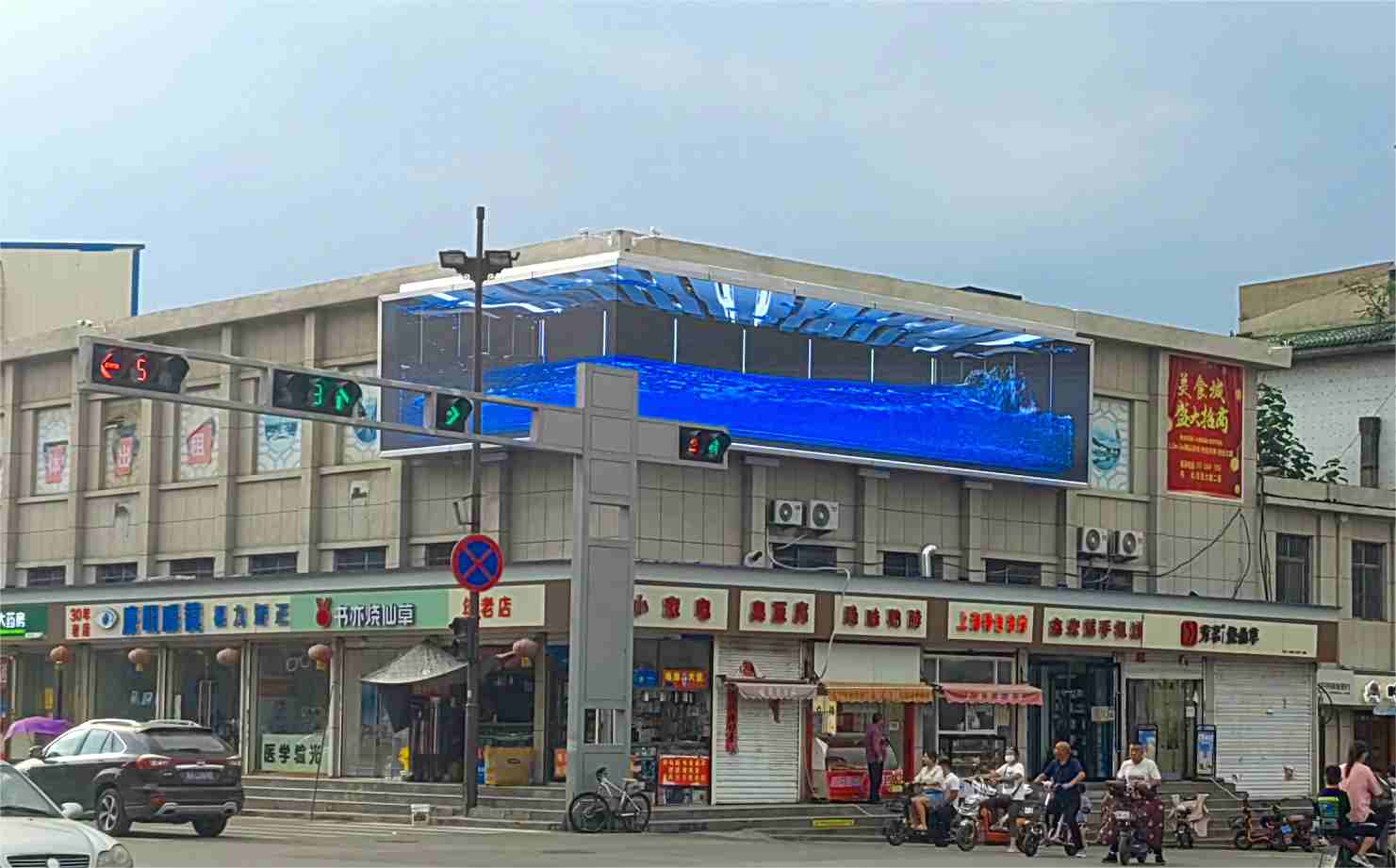
Its main logic is only one, that is, the location you are in is essentially a glass curtain wall or an open space. Adding a transparent screen here is equivalent to creating an extra place for advertising out of thin air. This approach will neither affect the entry of light nor block the passage of sight. Customers standing outside can still clearly see the store personnel selecting clothes.
I've also encountered scenarios where it's not ideal for use, such as indoor corridors, enclosed meeting rooms, and spaces with no windows on all sides. Because the contrast of a transparent screen is inherently lower than that of an ordinary black-bottom LED screen, in an environment where light is reflected from all sides, the screen will look gray, resulting in blurred writing.
If your venue itself is very dark and there are no windows around it, then it will be more cost-effective to just use a conventional LED screen. Do not force the use of a transparent screen to join in the fun.
Is the brightness of the transparent screen enough?
This situation needs to be judged based on the direction you are facing and whether the lights are turned on during the day. Since my store is facing the road, there will be direct sunlight at noon. When the brightness is adjusted to 3,500 nits, if you shoot with a mobile phone from a distance of 20 meters, you can see the picture clearly. However, if you stand at the door of the store and watch it directly with your eyes, you will feel that the edges of the text are somewhat blurred and blurred. After the evening time passes and the brightness is reduced back to 2,000 nits, you will find that the picture becomes much clearer, and the overall visual effect will be better than during the day.
When you choose a screen product, don't just focus on the maximum brightness value marked on the parameter table. You should ask the manufacturer in person. Specifically, you need to ask: how long does your installation location receive sunshine every day, what is the approximate light transmittance of the glass material used, and how many nits of brightness are recommended by the manufacturer based on these conditions. I personally initiated consultations with three different suppliers in the final stage. Two of the companies gave a suggestion of 2,500, while another company gave a suggestion of 3,500. After comprehensive weighing, I finally chose a compromise plan and settled on the price of 3,000 yuan nit. From the perspective of actual use experience, this brightness configuration is the most comfortable. It will neither dazzle the eyes nor make the picture too dim.
What should you pay attention to when installing a transparent screen?
When it came to installation, I was really deceived by others. For the first supplier, the low price quoted to me did not include the cost of structural components. Halfway through the construction, the supplier informed us that the load-bearing capacity of the glass curtain wall was not enough and that additional steel structure construction was required. As a result, it cost an additional 3,500 yuan.
As for the second supplier, although the relevant content was included in the quotation, when we went to the site for inspection, we found that the power supply wiring needed to be routed around the ceiling. For this reason, an additional cost of 800 yuan was added.
My suggestion is that before signing the contract, you must list the installation fees, structural components, power wiring, and debugging separately and write them into the contract text. Do not let them be hidden in the so-called total price.
The store I visited signed the agreement in this way. The total amount finally established was 4,300 yuan and included all project contents, and then I was not asked to pay an additional penny. In addition, the transparent screen module is relatively heavy. After the screen with a length of four meters is hung, the weight will reach 70 or 80 kilograms. The load-bearing embedded parts of the glass curtain wall must be checked or reviewed by a structural engineer. Never use expansion bolts to fix a few points at will and then end the problem.
Let's go back to the topic itself. The transparent screen technology has achieved a high degree of maturity at the technical level, so there is no such thing as a stage that has not yet been developed and perfected. What really causes people's hesitation is never the quality of the screen equipment itself, but the unclear quotation situation, push-and-pull during the installation process, and the inability to contact the after-sales service personnel.
I clearly wrote the specific indicator of the after-sales service response time that the supplier needs to provide into the contract terms, and stipulated that if the staff cannot arrive on site within 48 hours to handle the problem, 20% of the final payment will be deducted as a severe penalty. It is precisely because of this single constraint that they take this work more seriously than any other service provider I have contacted before. Merchants who open stores know very well that if there is an equipment failure, it will affect the fact that they can open the door to welcome customers the next day. Therefore, it is wrong to never save money in the after-sales process.



